Jitendra Nath Misra
From the stables of Maharaja Ranjit Singh came horsemen and foot soldiers wielding curved sticks and woolly balls. They were headed west. The Persian Polo army was waiting at the west bank of the Sindhu, but war across the mighty Sindhu was not in anyone’s mind. It was a hockey match between the two armies, played in the fashion of the Middle Ages.
Lest I run away with an imaginary tale, in the Middle Ages Persians did indeed play hockey on horseback, while people in Punjab played a form of hockey called Khido Khundi (khido is to play, khundi is a ball made of wool). Despite indigenous roots on both sides of the Sindhu, modern hockey came to India after Dalhousie’s forces defeated the Sikh empire. The Indian Army was to learn to play hockey in the open fields of Punjab in the 1850s.
Fifty years later, India was the best. India won 18 of 21 matches in the 1926 tour of New Zealand. About the tour of England in the 1927- 1928 season, a journalist under the pseudonym Wanderer writes in Western Morning News, quoted in Scroll: “Those who still think that England is supreme at the game must surely look further afield now.” Between 1928 and 1956, India earned six successive Olympic gold medals winning 24 consecutive matches. Two of hockey’s greatest players on either side of the Second World War are Indian – Dhyan Chand and Balbir Singh Sr., each earning three Olympic gold medals. The great Chand had no reason to burnish his image in cameo talk shows or showery praise. So too Balbir Singh Sr.- though how his tale of greatness remained lesser- known is curious.
Indians are crazy about cricket, but hockey is their beloved sport. The artwork of Indian players instils admiration and hope. Tim White, the commentator, says, “the technical skills of the Indians are a joy to watch.” Australia’s hockey developed in Indian hands. Don Bradman called Indians “better exponents of that game than Australians.” The Indian political thinker Yogendra Yadav says hockey in the 1970s embodied the “pride of the underdog.” Positive emotion is a good reason to write about a sport untainted, enjoying a loyal and growing fan base, everywhere.
Those not born in India might or might not understand. Hockey is the only Olympic sport in which India has excelled, earning 13 medals- eight gold, one silver, and four bronze. 8 of India’s 10 Olympics gold medals have been in hockey. India won the gold medal at the 1948 London Olympics despite the migration of elite Muslim and Anglo-Indian players to Pakistan and Australia. How does a nation, jolted by the violence and chaos of Partition, recover to win an Olympic final 4-0? Singh Sr. reflects upon what the gold medal at London meant: “As the flag was going up, I felt as if I was going up too.” The decline from the 1960s did not mean the nation had lost hope.
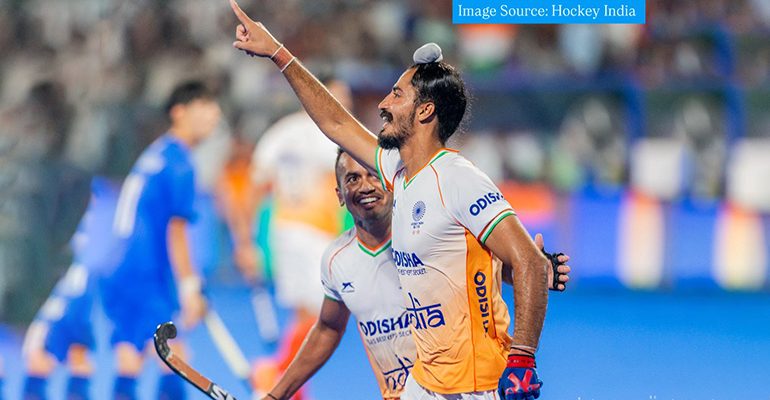
After decades of determined development, India earned an Olympics bronze medal at Tokyo 2020, ending a 41 year wait. Players cried into the camera as the Olympics website hailed the match as one of the best. Four years later, at the 2024 Paris Olympics, India earned another bronze medal – the only men’s team to win back-to-back medals, a feat achieved after 52 years. Prime Minister Narendra Modi said on X, as quoted in The Print: “Every Indian has an emotional connect with Hockey.” This would be remembered “for generations to come!”
Why would a bronze medal in the Olympics hold meaning for generations? Modi’s statement was linking sport to identity. “Hockey is more than just a sport for us – it’s a symbol of our national pride,” Sports Minister Mansukh Mandaviya would assert. Yadav, not a passionate hockey follower, said: “The resurgence of Indian hockey in this context assures me that another, deeper and positive nationalism still lives inside us.”
India is the only country with an uninterrupted tradition of hockey writing. Hockey films like Chak De India and Gold were firsts anywhere. A student of hockey is like a hopping deer seeking to make sense of the forest, but few display such spirit. It’s easy to get lost in jargon (such as “half-court press,” or “on-the-ball running”) and data. Dramatisation doesn’t build understanding. Hockey is history unfolding, with something new revealed before us every time. Let us bow to India’s revival – not in the spin of news cycles, but with reverence for an uncontaminated success. Put less poetically, Indian hockey is power and defiance, serving as a study in foreign relations.
How? The resurgence of hockey aligns with the resurgence of foreign relations. India’s failure to assert authority within Fédération Internationale de Hockey (FIH) bodies meant it could not prevent the introduction of artificial surfaces in 1976 – a change that proved calamitous. But as Ravi Kant Srivastava, Director General of Hockey India, says, India now innovates and the world adopts. The four-quarters format, which India pioneered, helps “India’s players who aren’t as strong as Europeans.” This becomes a conversation on economics. Thierry Weil, the former FIH chief executive, once said: “How can you generate more revenue without having a country like India [being] a part of it?” While performance depends upon skill and tactics, the market also plays a decisive role.
Paradoxically, the European hockey powers need India’s money to maintain their stranglehold over elite events. Isn’t there a connection between geopolitics and hockey? In hosting such events, India earns both praise and criticism.
With increased funding, India has imported coaches and adopted modern tactics, and the three coaches who brought Olympic success have been foreigners – Graham Reid, Craig Fulton, and Sjoerd Marijne. At the 2020 Olympics, the women’s team narrowly lost to Great Britain in the bronze medal match.
The history of Indian hockey is replete with triumphs and travails. It deserves biographers working in solitude, helping us understand a Lone Star sport that has carved out honourable careers for amateur – professionals. The power of sport in the international system is worthy of a higher canon of authorship – one that sidesteps personal stories and aspires to a foundational contribution. Don’t turn writing into dark art, don’t let rivalries get caught in the crosshairs of narcissism, remain true and morally consistent. Just celebrate Indian hockey for what it is – a part of India’s cultural DNA.
Author Biography
Jitendra Nath Misra is a Senior Fellow at the Jindal India Institute. He is a former Ambassador and Professor of Diplomatic Practice at Jindal School of International Affairs. He is the editor and co-author of Radhaland and Worlds Beyond.