The Language of Trade: Rhetorical Sanctification and the Empirical Underpinnings of India’s Global Partnerships
January 16, 2026 2026-01-16 0:20The Language of Trade: Rhetorical Sanctification and the Empirical Underpinnings of India’s Global Partnerships
The Language of Trade: Rhetorical Sanctification and the Empirical Underpinnings of India’s Global Partnerships
By Soham Das
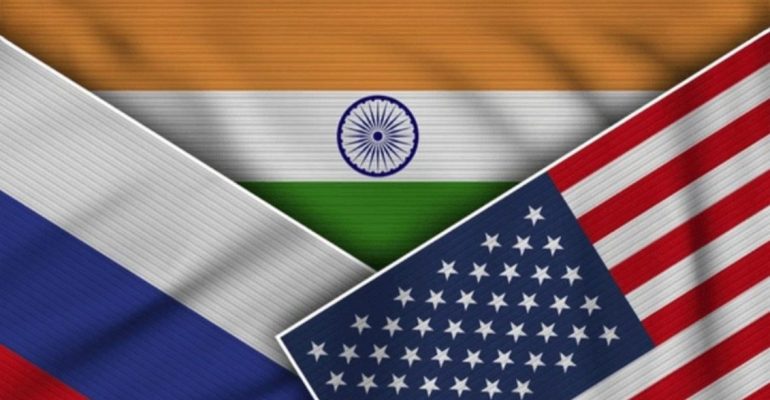
As India prepares to celebrate its 77th Republic Day on January 26, 2026, this analysis explores the nation’s trade relations through a comparative lens. The “elephant in the room” is the intensifying trade war and the proliferation of tariff barriers, sparked by the USA’s imposition of tariffs on its trading partners. India, a long-standing strategic partner, now faces a staggering 50% additional tariff because of the Government of India’s (GOI) decision to maintain Russian oil imports to satisfy strategic autonomy and energy requirements. Consequently, Indo-Russian trade has multiplied over the past few years, with a growth trajectory significantly steeper than that of Indo-USA bilateral trade.
This piece presents original research that visualizes Indo-Russian and Indo-American trade values. It further provides a comprehensive text analysis of Prime Minister Modi’s addresses during visits from foreign leaders, including Russian President Vladimir Putin and UK Prime Minister Starmer, as well as his speech at the ASEAN 2025 summit and US Vice President JD Vance’s address in Jaipur during his visit to India last year.
While there is little debate that Prime Minister Modi’s interpersonal relationships with world leaders bolster India’s strategic standing at institutional and ideational levels, their specific impact on the structural aspects of diplomacy remains a critical area for analysis. Sentiment analysis of President Trump’s executive orders on tariffs reveals a characteristically negative-to-neutral tone regarding trade relations. The “America First” rhetoric, the heightened focus on U.S. Customs and Border Protection, and the condemnation of indirect Russian oil flows are not superseded by President Trump’s occasional references to PM Modi as a “good guy” or a “great man” during his candid remarks. Contrarily, JD Vance’s formal address in India reflects a far more positive sentiment, emphasizing economic cooperation and shared priorities. In my opinion, this duality in the U.S. approach must be handled with caution, given that the USA remains India’s primary trading and strategic partner.
Trade Volume Analysis
The following charts visualize the trade volumes between India-Russia and India-USA from 2004 to 2024. Data for Indo-US trade is sourced from the Ministry of Commerce (DGCIS), while Indo-Russian statistics have been collated from the Ministry of Commerce & Industry and Indian Embassy records.
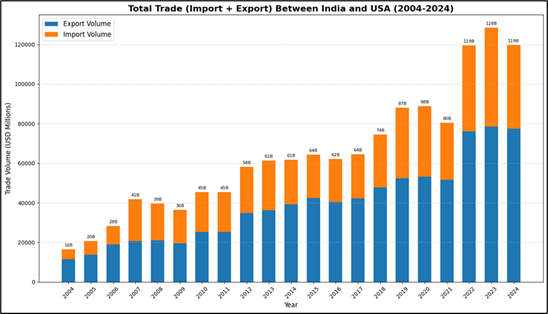
Chart 1: India-USA Trade 2004-2024. Curation and Visualization: Author (Python on Google Colab)
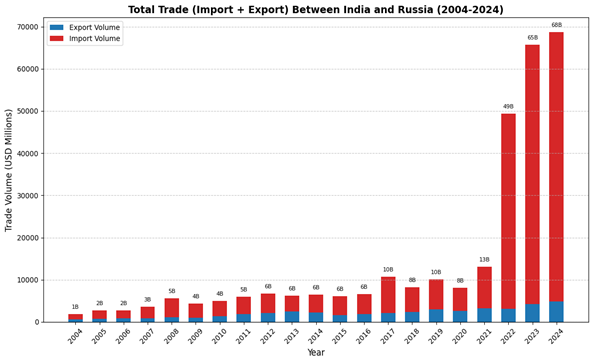
Chart 2: India-Russia Trade 2004-2024. Curation and Visualization: Author (Python on Google Colab)
Textual Analysis and Rhetoric
I analyzed a selection of Prime Minister Modi’s addresses to determine India’s institutional and ideational standpoint regarding global trade. These speeches are more than ceremonial; they institutionalize consent, consolidate national sentiment, and construct a vision of India where trade, strategic partnerships, and strategic autonomy are sanctified through rhetoric.
The thematic focus of these addresses varies significantly based on the diplomatic partner, reflecting distinct priorities in India’s global engagements. For instance, the analysis of President Putin’s visit highlights a deep-rooted strategic alignment through recurring themes of “cooperation,” “friendship,” “partnership,” and “energy.” In contrast, the discourse surrounding Prime Minister Starmer’s visit signals a shift towards a more modern framework for economic collaboration, with a clear emphasis on “trade,” “agreement,” and “innovation.” This drive for strategic cooperation is not reserved solely for global superpowers; the Prime Minister’s ASEAN summit speech emphasizes the importance of the region by prioritizing “security” and “partnership”. Finally, a more optimistic economic narrative from the U.S. executive branch emerges in JD Vance’s Jaipur address, where a focus on the “future,” “energy,” and “prosperity” illustrates a forward-looking vision for the bilateral relationship.
Below is presented the word cloud from PM Modi’s two formal addresses during Russian President Putin’s visit to India.
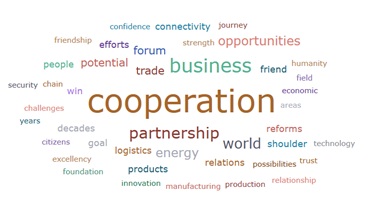
Source: Author’s visualization based on speech transcripts from the Ministry of External Affairs (MEA) archives and narendramodi.in. Cloud generated using terms mentioned at least three times by Prime Minister Modi.
Below is presented the word cloud from PM Modi’s two formal addresses during United Kingdom’s Prime Minister Starmer’s visit to India.
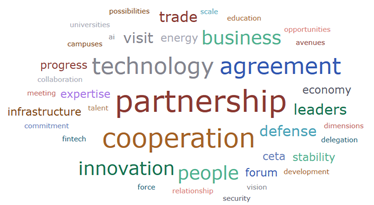
Source: Author’s visualization based on speech transcripts from the Ministry of External Affairs (MEA) archives and narendramodi.in. Cloud generated using terms mentioned at least three times by Prime Minister Modi.
Below is presented the word cloud from PM Modi’s formal address at the 2025 ASEAN Summit.
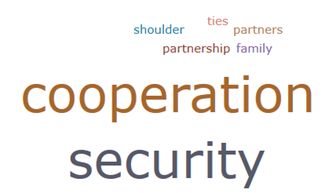
Source: Author’s visualization based on speech transcripts from the Ministry of External Affairs (MEA) archives and narendramodi.in. Cloud generated using terms mentioned at least two times by Prime Minister Modi.
Finally, below is presented the word cloud from U.S. Vice President J D Vance’s formal address at Rajasthan International Centre on 22nd April 2025, during his visit to India (transcripts sourced from in.usembassy.gov).
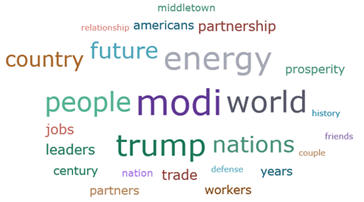
Source: Author’s visualization based on speech transcripts from the US Embassy archives. Cloud generated using terms mentioned at least five times by U.S. Vice President J D Vance.
This analysis recognizes a shift toward “complex interdependence” as theorized by Robert Keohane and Joseph Nye, where deep economic ties coexist alongside significant political frictions. India’s trajectory illustrates that modern trade is no longer a binary choice; instead, the nation employs a “strategic autonomy” framework to balance divergent interests, which includes securing energy through Russia while maintaining high-tech and defense cooperation with the USA. The contrast between President Trump’s protectionist rhetoric and JD Vance’s partnership-focused discourse also reiterates the “duality” of modern power dynamics. As India navigates this era of “strategic hedging,” its rhetorical construction of partnership serves as a vital tool for legitimizing and institutionalizing a multi-aligned foreign policy within an increasingly transactional global order.
Author Biography
Prof. (Dr.) Soham Das is an Assistant Director at the Jindal India Institute. He is an Assistant Professor at the Jindal School of International Affairs and the Founding Director, Centre for Analytical Research and Engagement (CARE), O.P. Jindal Global University.