The world today has been constantly going through a roller coaster of transitions in the international security sphere. Countries are persistently looking to expand their bilateral relations and are investing in trilateral and multilateral partnerships, aiming to build trustworthy and dependable cooperation. In the present context of global relations, the most poignant need of the hour in international politics is trust and support. In this regard, one partnership that has flourished and continued to blossom is the ever-growing friendship between India and Japan. Though geographically distant, both countries have, culturally and historically, fostered the seeds of early cooperation, paving the way for a stronger relationship in the domains of economic growth and development, security and strategic partnership, and people-to-people exchange and interactions.
Where all can the collaborations happen?
India and Japan have continued to follow their traditional methods while also developing themselves in the present global scenario. Both countries are culturally vast and varied, yet they share a common tradition of treating their guests with utmost respect. India believes in the concept of ‘Atithi Devo Bhava’, where the guest is treated like a god and offered the best possible hospitality and warmth. A similar concept exists in Japanese culture, known asomotenashi (hospitality), which emphasises selfless service delivered with attention, sincerity and care.
Since both countries share this cultural aspect, the hospitality industry can be further cultivated as an important area of collaboration. Since 2007, the AJU Japanese Group of Hotels has been at the forefront at delivering hospitality services in Indian cities such as Gurugram, Manesar, Neemrana, Ahmedabad and Vithlapur – primarily catering to Japanese guests. However, to expand their business in the hospitality domain, it is essential to widen the clientele to include Indian guests and other international visitors. The cities AJU operates in are major business hubs where international meetings and conferences take place, creating potential to generate additional revenue for these Japanese hotel groups. A similar effort can be explored by Indian hotel chains, as currently there are no Indian hotel groups in Japan. Although there were discussions about joint collaborations in 2007, they did not fructify at the time.
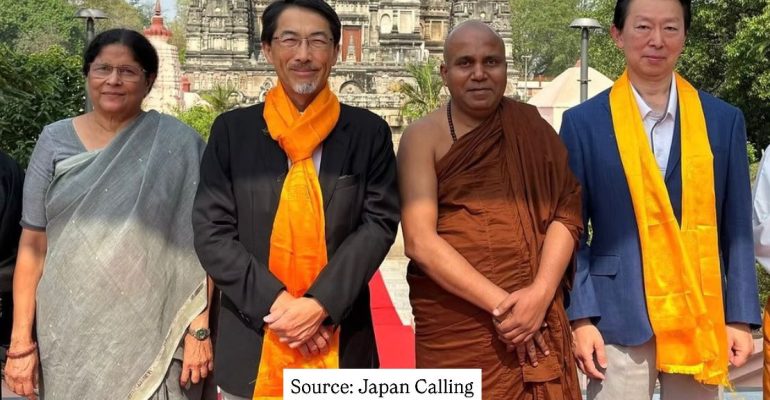
Another area of cooperation that can be further developed between India and Japan is the tourism sector. The year 2025 has been designated as the India-Japan Tourism Exchange, and the 4th Joint Working Group Meeting on Tourism Cooperation took place on 8th April 2025. During the meeting, both sides discussed the need to promote Buddhist tourism for Japanese visitors, improve air connectivity, and encourage visits by Japanese students to India. These initiatives would significantly enhance cooperation in the tourism domain. Discussions also highlighted the opportunity to curate itineraries specifically tailored to the needs of Japanese tourists.
There is a need to develop and promote the Buddhist Circuit by creating itineraries that include Japanese-speaking guides, and offering packed lunches or meal plans from Japanese restaurants. This would not only introduce and promote Japanese cuisine in India but also create a market for Japanese restaurants at these tourist sites, ensuring greater comfort and willingness among Japanese travelers to visit India. Another potential area involves enabling Indian chefs trained in Japan to set up restaurants in Buddhist Circuit destinations. This could help create a cluster of restaurants owned by Indians trained either in Japan or by institutions such as the Institute of Hotel Management, Catering and Nutrition (IHM) Pusa – serving Japanese cuisine using local Indian ingredients. Such initiatives would support the local economy while expanding food choices for Japanese tourists. These tourist areas could develop ryokan-style stays, with Japanese hotel groups collaborating with Indian hotels to offer authentic experiences. This would make travel more memorable and comfortable for Japanese visitors. If such ventures prove successful, they could significantly boost Japanese tourism to India.
The domain of education is another lucrative area of cooperation. Student exchanges already take place through scholarships such as those offered by the Indian Council for Cultural Relations (ICCR) for Japanese students. Private universities, like the O.P. Jindal Global University, have also expanded their efforts. The university recently announced five new short-term abroad programmes in Japan for the summer of 2026, in collaboration with institutions such as the University of Tokyo, Chuo University, University of Yamanashi, Kyorin University, and Musashi University. These initiatives aim to deepen academic and cultural exchange among students. However, the need of the hour is to build more research-centric opportunities between the two countries’ education sectors. This can be strengthened through joint degree collaborations that would train the students in specialised areas where India and Japan individually excel. Such degrees should be curated in a way that they also open pathways for future employment opportunities – both in specialised and general fields. Additionally, increased support for vocational training would help meet the needs of sectors crucial to economic development and ensure a steady supply of skilled workers.
A True Partnership
India and Japan have flourished because of the immense trust and support they share. This friendship has stood the test of time, with both countries engaging on an equal footing. Today, their partnership still holds several untapped areas that can be further explored and developed. Strengthening cooperation in hospitality, tourism and educational exchange will promote greater people-to-people interaction, helping create more opportunities and deepening the bond between the two nations.
Author Biography
Gitanjali Sinha Roy is an Assistant Director at the Jindal India Institute. She is an Assistant Professor of International Relations, Indo-Pacific Studies and Japanese Studies at the Jindal School of International Affairs, O.P. Jindal Global University.