Sriparna Pathak
The 21st century has witnessed several geopolitical changes that question the very foundation of the rules-based international order that was established after the Second World War. The conflicts between Russia and Ukraine and Israel and Iran, among others, have created an epoch of history where the world is witnessing the re-emergence of large-scale conflicts.
What has emerged as a potent challenge, and yet lacks a global consensus, is the scourge of terrorism. As opposed to conventional wars – on which there is largely a consensus among global actors, as well as norms in the form of declarations against military escalation or even a mention in the charter of the United Nations (UN) – terrorism leverages violent non-state actors, due to which pinning down culpability on states is difficult. Owing to this particular nature of terrorism, states have utilized it as a tool against other state actors.
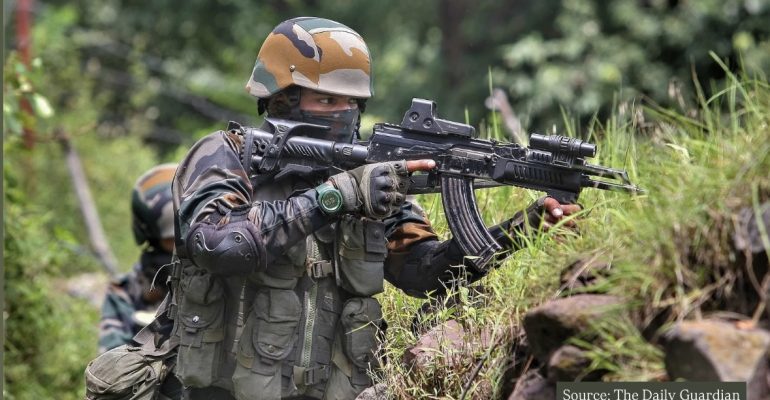
In this context, Pakistan’s state sponsorship of terrorism becomes a case in point. While India and Pakistan have had conventional conflicts, the Pakistani state also has leveraged terrorism against India. This has been seen in several instances including the 1993 Mumbai bombings, the 2001 Parliament attack, the 2006 Mumbai train bombings, the 2008 Mumbai terror attacks, the 2016 Pathankot airbase attack, the 2016 attack on India’s Army base in Uri, the 2019 Pulwama attack, and the latest one on civilians in Pahalgam in 2025.
Pakistan has used proxy groups like the Lashkar-e-Taiba (LeT) and the Jaish-e-Mohammed (JeM) to fuel insurgency in Kashmir, in the hopes of one day occupying the territory through the malicious usage of terrorism. India’s call- out of Pakistani state-sponsored terrorism is backed by patterns of militant activity, as well as international corroboration. It is important to note that the LeT was designated as a terrorist group by the UN Security Council’s (UNSC) Al-Qaeda and Taliban sanctions committee under Resolution 1267. The JeM was designated under the same UN Security Council Resolution 1267 in October 2001 for its ties to Al-Qaeda and its involvement in terrorist activities, including the 2001 Indian Parliament attack and the 2019 Pulwama attack.
Thus, India’s collaborations with like-minded nations are crucial as several partners in the West have often aided India’s bids to blacklist terrorists and organisations from Pakistan. Given the fact that the 21st century has witnessed the emergence of powerful actors from the East, a mention of China is pertinent in this context. While China is the second largest economy in the world and has a significant clout in international relations, its relationship with the U.S. or with India for that matter, have been a queer mix of cooperation and conflict. While China also claims to understand the scourge of terrorism, its actions in combating international terrorism reveal a completely different picture. In this context, an analysis of China’s position on the 2025 Pahalgam terrorist attacks and India’s response in the form of Operation Sindoor becomes important.
To begin with, China refrained from calling the Pahalgam attacks as ‘terrorist attacks’, and called for a “fair and just investigation” into the matter. Furthermore, the Chinese Foreign Minister Wang Yi stated, “China fully understands Pakistan’s reasonable security concerns and supports Pakistan in safeguarding its sovereignty and security interests”. It is pertinent to note that China did not issue any such statement for India, the victim of the terror attack! Xu Feihong, the Chinese envoy in India, had simply tweeted on X, offering condolences for the victims, and stated that China opposes terrorism of all forms.
At the UN, Pakistan with support from China, ensured that the UNSC statement draft on the Pahalgam attack, issued on April 25, was watered down, and insisted on omitting a reference to The Resistance Front (TRF) (a proxy of the LeT that carried out the attacks in Pahalgam) and changed a sentence that asked members to cooperate with the “Government of India” to “all relevant authorities” for the investigation into the terrorist attacks in Pahalgam. This is not the first time that China has leveraged Pakistan sponsored terrorism against India and prevented listing of such terrorists at the UN’s 1267 committee. India made multiple attempts to list Masood Azhar as a global terrorist in 2009, 2010, 2016, 2017 and 2018, and China blocked these proposals each time often using “technical holds”, claiming “inadequate information” or lack of consensus. In June 2022, China placed a “technical hold” on a joint India-U.S. proposal to list Abdul Rehman Makki under the 1267 Committee. In August 2022, China blocked a joint India-U.S. proposal to list Abdul Rauf Azghar as a global terrorist, and it did the same again in 2023. In September 2022, as well as in June 2023, China blocked a joint India- U.S. proposal to designate Sajid Mir as a global terrorist. In October 2022, China placed a “technical hold” yet again when India-U.S. jointly proposed to list Shahid Mahmood as a global terrorist. In October 2022, China blocked a joint India-U.S. proposal to list Talha Saeed as a global terrorist, and blocked a subsequent attempt in 2025 as well. Thus, as is clear from ample evidence, Pakistan’s state sponsored terrorism against India is well supported and encouraged, as China continues the blocking spree of India’s and its Western partners’ attempts to tackle international terrorism.
The queer bit is that at the Shanghai Cooperation Organisation (SCO), where China is a heavyweight, there is a consistent push for stronger regional cooperation against what China calls the three evils of terrorism, separatism and extremism. In 2017, China, in fact called for a specific SCO counter terrorism plan targeting these three evils and highlighting the need for coordinated action among member states. India is an active member of the SCO. However, China’s actions on countering international terrorism speak volumes about its actual stance on using state sponsored terrorism from Pakistan against India.
What needs to be remembered is that China and Pakistan are all-weather friends. Pakistan even gifted the Shaksgam Valley to China – a territory Pakistan had illegally occupied, and now China occupies. The Sino-Pakistan agreement signed in 1963 was called an agreement to settle border disputes between Pakistan and China, specifically in the Trans-Karakoram Pact. What was conveniently brushed aside was the fact that Indian territory, illegally occupied by Pakistan, was ceded to China, and China was more than happy to bypass the Indian concerns.
China is the largest arms provider to Pakistan. In fact, even after the temporary pause in Operation Sindoor in May this year, Pakistan is reported to have received a fresh batch of 40 Chinese J-35 stealth fighter jets along with KJ-500 airborne early warning and control aircraft and HQ-19 ballistic missile defence systems from China. China’s state-controlled media, during Operation Sindoor pushed disinformation on the supremacy of China supplied Pakistani jets and how they had countered India’s jets. However, fact checks by the Press Information Bureau and the Indian Embassy in Beijing pointed out how Chinese jets used by Pakistan had actually suffered terribly at the hands of the Indian Air Force.
China’s support to Pakistan across realms ranging from diplomatic support at the UN, economic and military support, among a long list of others, can only be understood through its conscious attempts to curtail India’s rise, economically, diplomatically, culturally and otherwise. The rational basis for China’s cooperation with Pakistan, is otherwise impossible to trace. What needs to be understood by India is that China’s ancient treatises on statecraft and warfare, ranging from Sun Tzu to current foreign policy formulations, leverage the usage of deception. While China keeps preaching similarities with India and the desire to shape unfolding international relations, the reality is different, and India needs to understand who the actual bogeyman behind Pakistan is.
Author Biography
Sriparna Pathak is a Senior Fellow at the Jindal India Institute and serves as Professor and Associate Dean of Careers at the Jindal School of International Affairs (JSIA). She is also the founding Director of the Centre for Northeast Asian Studies at O.P. Jindal Global University (JGU).