
Fuelling the Future: India’s Push for National Green Hydrogen Mission
June 19, 2025 2025-06-19 15:11Fuelling the Future: India’s Push for National Green Hydrogen Mission
Rohith Jyothish and Vanshika Singh
Energy demand for India is expected to increase by 35 percent by 2030 (India Energy Outlook 2021). India’s hydrogen demand in 2020 was recorded at 6 million tonnes per annum and it is estimated that this demand will further increase fivefold by 2050 (Kambali, 2024). In addition, at the United Nations Framework Convention on Climate Change (UNFCCC) COP 26, India pledged to the Panchamrit – a set of five national targets as its Nationally Determined Contributions (NDCs). All of these targets entail an inherent focus on renewable energy.
However, traditional renewables, like solar energy and wind energy, face key issues of variability and uncertainty. Further, India has yet to determine an effective way to integrate renewables into the grid. Though storing these renewables is easier through batteries, it comes with its own set of problems like dependence on China for lithium and rare earth minerals, reliability of batteries and the toxic chemicals associated with them. Moreover, sectors like industry and heavy transport are challenging to decarbonise with the existing carbon technologies. Hydrogen, on the other hand, is a clean secondary source which is easy to transport. Green hydrogen, produced through electrolysis of water, is a clean fuel as zero carbon emissions are produced as a by-product.
About the Mission
The National Green Hydrogen Mission (NGHM), announced in 2021, was approved by the cabinet in January 2022. The initial phase of the policy was launched by the Ministry of Power in February 2022, setting the foundation for India’s hydrogen ecosystem. It focused on addressing supply-side challenges by reducing the cost of hydrogen production. With an initial outlay of INR 19,744 crores, it seeks to position India as the leading country for producing, utilising and exporting Green Hydrogen and its related products. The mission aims to achieve the target 5 million tonnes per annum of green hydrogen production by 2030, while increasing the country’s renewable energy capacity to approximately 125GW.
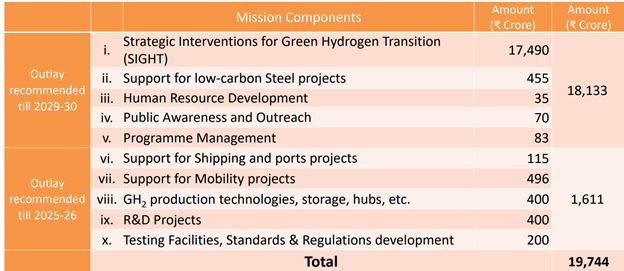
Source: Screenshot of Review of NGHM (World Resources Institute)
Reproduced for educational purposes under fair use
The NGHM outlines a two-phase strategy for sectoral growth. The first phase is set for 2023-24 to 2025-26 and focuses on integrating hydrogen in key sectors like refineries and fertilisers, where easy adoption as a fuel can be facilitated. The second phase, set from 2026-27 to 2029-30 will focus on the rapid expansion of green hydrogen to make it cost-competitive. Large scale projects will also be supported in sectors like steel, mobility and shipping with ongoing R&D to eventually extend to sectors like railways and aviation.
Current Progress
Though the mission is in its early stages, investments and policy support have been in place. Policy measures have been initiated to lower renewable energy costs by the Ministry of New and Renewable Energy (MNRE), the Ministry of Power and the state authorities. The World Resources Institute lists down state level policy actions. Uttar Pradesh has drafted an ambitious Draft Green Hydrogen Policy which provides significant incentives for businesses in the sector, such as a 14-year exemption from various charges. The policy has a special focus on electrolyser manufacturing as well. Madhya Pradesh’s Renewable Energy Policy has introduced tailored incentives for green hydrogen. The policy aids project financing through an interest subsidy of up to 5% for six years. Additionally, it provides a five-year exemption from electricity taxes, green industry incentives reaching ₹1 crore, and State Goods and Services Tax (SGST) refunds on capital equipment. Odisha is dedicated to establishing two green hydrogen and green ammonia hubs in the state. Further, green hydrogen projects have been exempted from cross-subsidy surcharges and state transmission charges for 20 years. There is a 100 percent exemption from electricity duties for 20 years, starting from the date of commercial production. Gujarat is offering SGST reimbursement of 80-100 percent for a period of 10 years.
Other than state-led efforts, various institutions have also geared up. Gas Authority of India Limited (GAIL) launched the country’s first project to blend hydrogen into the city gas distribution network in Indore, Madhya Pradesh. National Thermal Power Corporation (NTPC) Limited began blending green hydrogen up to 8 percent into the piped natural gas network at its Surat facility. NTPC has also deployed hydrogen-powered Fuel-Cell Electric Vehicle (FCEV) buses in Uttar Pradesh, and Leh.
Challenges to Green Hydrogen
NITI Aayog’s report on Harnessing Green Hydrogen highlights issues such as high costs, complex supply chains and regulatory issues in building a green hydrogen economy. Further, hydrogen can be produced via multiple ways and can be used in various industries, thus making its supply chain more intricate compared to oil and gas. For India, high production costs, which are currently at approx. $4-5 per kg, remain a significant issue and need to come down to around $2 per kg (World Economic Forum, 2024). Transportation and storage are also key issues thus requiring substantial investment to upgrade infrastructure. Further, resource shortages need to be addressed. According to the International Energy Agency, electrolysing water takes up to 9 litres of water for every kilogram of hydrogen produced.
Way Forward
A way in which India can take lead is by experimenting with public ownership and partnership in green technology that challenges the dominance of private players in this space from the global north. India can consider a green industrial policy with active state support via state-owned banks, public procurement which guarantees demand and export promotion via subsidies. Existing models in the global south include that of Namibia’s state-owned hydrogen-fuel based locomotive company and Uganda’s electric bus factory (Gabor and Sylla, 2023). This will allow India to emulate the history of successful state-led industrial policy elsewhere in the world.
Authors Biography
Vanshika Singh is an M.A. Public Policy student at the Jindal School of Government and Public Policy, and a research intern in our ‘Successful Forest Conservation Strategies: An Indian Solution to the Global Problem of Deforestation’ project.
Rohith Jyothish is a Fellow at the Jindal India Institute and an Assistant Professor at the Jindal School of International Affairs.