Indian Wisdom and the Inner Development Goals: Pathways to Achieving the SDGs
September 18, 2025 2025-09-18 4:43Indian Wisdom and the Inner Development Goals: Pathways to Achieving the SDGs
Indian Wisdom and the Inner Development Goals: Pathways to Achieving the SDGs
Naresh Singh
In this note, we show how insights from India’s spiritual traditions, such as Advaita Vedanta and Buddhism, can strengthen the Inner Development Goals (IDGs) in their thrust to support the achievement of the Sustainable Development Goals (SDGs).
Progress on human development has been poor, with persistent inequalities, inadequate access to education and healthcare, and significant setbacks due to the COVID-19 pandemic. These challenges have stalled improvements in living standards and well-being globally. In the past 10 years, healthcare and technology have improved significantly; however, these have not adequately reached people on the lower socio-economic ladder. Psychological well-being has declined, with mental health conditions such as anxiety and depression affecting around 1 in 5 people annually, and suicide rates rising among young people aged 15-29. It is therefore unsurprising that many Sustainable Development Goals (SDGs) targets remain off-track as global challenges continue to worsen daily. Countless efforts are being made to achieve SDGs by 2030, including policy reforms, international cooperation, increased funding, technological innovations, and grassroots initiatives. Yet, something seems to be missing. We have implemented nearly every solution in our arsenal, except for looking within. Inner changes in attitudes, values, and skills hold immense potential to influence significant outer transformations in social policy and progress towards the SDGs. The local farmers of the Timbaktu Collective in Andhra Pradesh, India, were driven by their deep connection to nature and a holistic view of life, which led them to work towards and achieve results in sustainable agriculture, organic farming, and ecological restoration. On a personal and collective level, inner transformations can lead to enhancement in well-being and quality of life. On an institutional level, the inner shift can take the form of effective public policies that are responsive to real-world challenges and policies that better reflect the needs and preferences of the community.
The complexity of the global challenges will require us to contemplate deeply about our inner selves and develop our inner capacity. The good news is that these inner abilities can be learned. Inner Development Goals (IDGs), an initiative focusing on fostering well-being and inner capacities to complement the Sustainable Development Goals (SDGs), articulates these skills and qualities with precision. IDG outlines a crisp framework of five categories that organize 23 skills and qualities of human inner growth and development. The five broad categories are: 1) Being – relationship to self, 2) Thinking – cognitive skills, 3) Relating – caring for others and the world, 4) Collaborating – social skills, and 5) Acting – driving change. These categories are further divided into 23 interdependent skills and qualities as shown below.
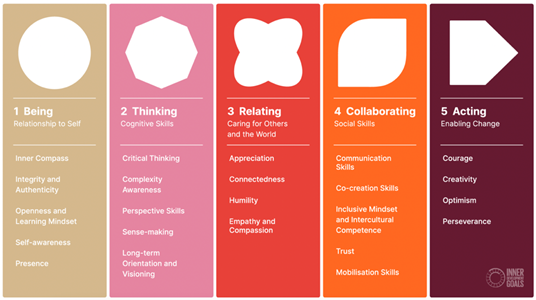
Table 1: Overview of the Inner Development Goals framework
Source: Inner Development Goals, https://innerdevelopmentgoals.org/framework/
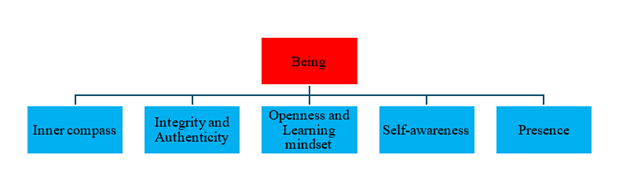
To offer an even stronger foundation and a deeper understanding of the IDG framework, we investigate various Indian spiritual traditions about the skills and qualities that are necessary to approach sustainable development and sow the seeds for a compassionate civilization. Examining our inner self is the first step toward self-awareness, leading to changed behaviour driven by experiential understanding. The first category in the IDG framework is ‘Being’ – Relationship to Self (Figure 1). Indian spirituality discusses this topic in-depth and offers diverse yet profound insights into the inner self – our interconnectedness with other beings and nature, our interdependence, and the oneness of our self and the universe. Below we elaborate on some pertinent ideas from various Indian wisdom-traditions.
Figure 1: The first category of the IDG framework
Advaita Vedanta or non-dualistic Vedanta in Hinduism posits that the true nature of the self (Atman) is identical to Brahman (pure consciousness or universal self). The perceived separation between the Atman and Brahman is due to ignorance, and the realization of the non-dual nature of the self, known as self-realization- leads to liberation. Thus, knowledge of our being brings freedom and self-awareness, and the ability to see beyond dualities. This knowledge makes us see the divinity in ourselves and other beings. There are three components of Brahman – Being (Sat) is one of them which points to an eternal and unchanging nature of existence. The other two are consciousness (Chit) and bliss (Ananda).
Similarly,the Upanishads, a collection of ancient Indian texts that form the philosophical basis of Hinduism, emphasize the idea that the self (Atman) is eternal, unchanging, and identical to Brahman. According to it, the self is described as the inner witness, pure consciousness that observes the activities of the mind and body, but is itself unaffected by them. Key passages such as Aham Brahmasmi (I Am Brahman) in the Chandogya and Brihadaranyaka Upanishads highlight this non-dual understanding.
According to Jainism, every living being has a soul (jiva) that is eternal and individual. The jiva is inherently pure, possessing infinite knowledge, perception, bliss, and energy. It posits that true being is the state of a purified jiva, free from all distractions.
In the end, Buddhism offers a unique and slightly different perspective on Self, one that aligns closely with what the Inner Development Goals (IDG) framework describes as ‘Being’ (this is not similar to the being discussed in Buddhism since there is a clear distinction for Buddhists between being and self). Buddhist philosophy offers this through the principles of Anatta (Pali) or Anatman (Sanskrit), which translates to “non-self” or “no soul.” Even though this philosophy stands in contrast to the concept of a permanent, unchanging self or soul found in many other Indian wisdom traditions, it offers similar conclusions. According to Anatta (Non-Self), there is no eternal, unchanging self. Instead, what we consider to be the self is a collection of constantly changing physical and mental components (the five aggregates: form, feeling, perception, mental formations, and consciousness). Since everything is impermanent, clinging to the notion of a permanent self leads to suffering (dukkha). Understanding the non-self helps in reducing attachment and ultimately alleviates suffering.
In reference to the concept of Being, Buddhism talks about Pratityasamutpada (Dependent Origination). According to it, all phenomena arise in dependence upon other phenomena. Nothing exists independently or in isolation, including the self. Understanding dependent origination helps us see that the self is not a fixed entity but a process that is constantly being created and re-created by causes and conditions.
We can summarize the above in two main points. First, realizing the non-self-fosters a sense of compassion and reduces attachment to the ego. Second, individuals attain a state of equanimity and peace by letting go of clinging to a fixed self, thereby also reducing their own suffering. Because of these ideas, the conclusions of Buddhism’s take on self is similar to what Advaita Vedanta or IDG says about being.
These insights from Indic philosophy may help us in going beyond and deeper than just an intellectual understanding of our inner-self and the nature of reality. It has the potential to plant the seeds for lasting inner transformation on a societal level, thereby influencing public policies, politics, and the structure and governance of our institutions. Indian philosophies also address the remaining categories of the IDG, i.e., Thinking, Relating, Collaborating, and Acting, through concepts such as Seva (selfless service to others), Ahimsa (non-violence and compassion towards all living beings), and Karma Yoga (selfless action without attachment to the results) to name a few. Indian spirituality emphasizes a holistic approach to life and offers profound insights for achieving personal and collective well-being. It holds tremendous potential to address the missing link – our inner dimension – in the pursuit of sustainable development.
Authors’ Biography
Naresh Singh is a Senior Fellow at the Jindal India Institute. He is a professor and former Executive Dean at the Jindal School of Government and Public Policy.
Divya Bhatnagar is a former Lecturer at Jindal School of Government and Public Policy. She is also the Head of Communications at the Spirituality, Science and Policy Network.